This is the first of a multi-part series where I will try to provide value to the people behind me on the fast lane on ramp even as I begin my acceleration into the far left lane. I'm not a millionaire, so I know nothing about making a million.
Here's what I do know: Two years ago I was a jobless graduate with thousands in student loan debt and two graduate degrees in religion. Today, I have a net worth of around $100,000 and climbing fast, more than double my gross pre-tax income from my slow-lane job, and I did it using a few basic principles and slow-lane income sources. Here's what you won't be doing: Joining an MLM scheme, selling subscriptions, selling knives, selling make-up, or selling out your family's contact info. You won't be eating ramen and hot dogs either, or heating your house with leaves.
Now, $100k is chump change to anybody in the fast lane, but I notice that a lot of posters here are in their early-mid 20's (like I was), and trying to scrape enough cash together to get their journey started. I hope I can help, since I've just made it out of that proving ground. As a disclaimer, these rules are occasionally going to be practical and concrete, and as such, some of them will only apply to people who share my able-bodied American context.
To begin you must observe this succinct rule:
Rule 0. Work
I'm pitching process and not event, which is another way of saying I'm pitching results and not hokum. For my techniques to help you, you'll have to be working to get income. What my techniques are going to teach you to do is to live like a king on a captain's salary, with the hope that you won't be an idiot and will invest that extra in the fast lane. You're going to need an income source though, which means work, plain and simple.
Our protagonist for these exercises is going to be Mr. Scott Slowlane. Scott has failed about as hard as you can fail at making money in the United States: He's making the federal minimum wage of $15,080 per year. For the purposes of these exercises, we'll round that out to $15,000, because he probably missed a few days of work in there, and God knows Burger King doesn't have sick leave.
So, how does Scott amortize his money supply?
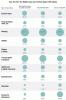
http://www.npr.org/blogs/money/2012...e-middle-class-and-the-rich-spend-their-money
If you look at this chart, you'll see that five of the items are out of proportion with the equivalent spending by the wealthy: His spending on housing, utilities, food at home, health care, and transportation. We'll target each of those in a later segment. This one is going to set down the first of several general rules that apply to all of them. Here is the next rule:
Rule 1. Never Lend Your Money Interest Free
What's that, you say? You've never lent your money interest free? Really? Ever bought one of these?

What you've done when you've purchased one of these cards is provided the company with an interest-free micro loan until the card is used up. What's more, if it's not used for some reason, the company stands to get a free dollar, or, you know, 41 billion.
It doesn't stop there though. I know all kinds of dutiful people who pay their rent a few days early, or pay their credit card bills off impulsively. What you're doing when you pay a bill before it's due is giving a company or entity some free interest. They weren't entitled to that money before the due date, so when they get it early, that money stops being your usable and/or interest earning liquidity and starts being the receiver's usable/interest earning liquidity.
You might not think that chasing these pennies down matters, but that's because you're on the sidewalk. While it's true that the money lost by Scott paying his rent and credit card bill days early might only be ten cents a month (assuming he keeps it in the bank), that mistake is going to come home to roost both in missed opportunities (Scott has a chance to quickly flip a MacBook his friend is selling, but the landlord and credit card company now have all his liquidity), and when I teach you how to prepare fast, healthy, balanced meals for yourself for less than a dollar. If Scott ever gets more money, and invests better, his choice to give others his liquidity interest free is going to be absolutely painful. Not only will he be giving away several days with much larger sums of money, and the opportunities that go with them, but the interest on that money if invested in a "higher" yield slow-lane type asset might leave him out $50 each year. Suddenly, we're not talking about sofa cushion money, we're talking about two tanks of gas or a cell phone bill (or, in my case, and maybe yours too, five cell phone bills).
Take away: Paying your (interest free) bills early, allowing passive withdraws of your money before the due date, or giving any kind of interest-free loans transforms your opportunities into your creditor's opportunities, and takes a small amount of money out of your pocket in interest as well. Any grace period you have without penalty (apartments, for example, will sometimes offer a grace period between two and five days every month without additional charges or even warnings), use it. That's five days of opportunity.
Continued below with rules 2+3!
Here's what I do know: Two years ago I was a jobless graduate with thousands in student loan debt and two graduate degrees in religion. Today, I have a net worth of around $100,000 and climbing fast, more than double my gross pre-tax income from my slow-lane job, and I did it using a few basic principles and slow-lane income sources. Here's what you won't be doing: Joining an MLM scheme, selling subscriptions, selling knives, selling make-up, or selling out your family's contact info. You won't be eating ramen and hot dogs either, or heating your house with leaves.
Now, $100k is chump change to anybody in the fast lane, but I notice that a lot of posters here are in their early-mid 20's (like I was), and trying to scrape enough cash together to get their journey started. I hope I can help, since I've just made it out of that proving ground. As a disclaimer, these rules are occasionally going to be practical and concrete, and as such, some of them will only apply to people who share my able-bodied American context.
To begin you must observe this succinct rule:
Rule 0. Work
I'm pitching process and not event, which is another way of saying I'm pitching results and not hokum. For my techniques to help you, you'll have to be working to get income. What my techniques are going to teach you to do is to live like a king on a captain's salary, with the hope that you won't be an idiot and will invest that extra in the fast lane. You're going to need an income source though, which means work, plain and simple.
Our protagonist for these exercises is going to be Mr. Scott Slowlane. Scott has failed about as hard as you can fail at making money in the United States: He's making the federal minimum wage of $15,080 per year. For the purposes of these exercises, we'll round that out to $15,000, because he probably missed a few days of work in there, and God knows Burger King doesn't have sick leave.
So, how does Scott amortize his money supply?
http://www.npr.org/blogs/money/2012...e-middle-class-and-the-rich-spend-their-money
If you look at this chart, you'll see that five of the items are out of proportion with the equivalent spending by the wealthy: His spending on housing, utilities, food at home, health care, and transportation. We'll target each of those in a later segment. This one is going to set down the first of several general rules that apply to all of them. Here is the next rule:
Rule 1. Never Lend Your Money Interest Free
What's that, you say? You've never lent your money interest free? Really? Ever bought one of these?
What you've done when you've purchased one of these cards is provided the company with an interest-free micro loan until the card is used up. What's more, if it's not used for some reason, the company stands to get a free dollar, or, you know, 41 billion.
It doesn't stop there though. I know all kinds of dutiful people who pay their rent a few days early, or pay their credit card bills off impulsively. What you're doing when you pay a bill before it's due is giving a company or entity some free interest. They weren't entitled to that money before the due date, so when they get it early, that money stops being your usable and/or interest earning liquidity and starts being the receiver's usable/interest earning liquidity.
You might not think that chasing these pennies down matters, but that's because you're on the sidewalk. While it's true that the money lost by Scott paying his rent and credit card bill days early might only be ten cents a month (assuming he keeps it in the bank), that mistake is going to come home to roost both in missed opportunities (Scott has a chance to quickly flip a MacBook his friend is selling, but the landlord and credit card company now have all his liquidity), and when I teach you how to prepare fast, healthy, balanced meals for yourself for less than a dollar. If Scott ever gets more money, and invests better, his choice to give others his liquidity interest free is going to be absolutely painful. Not only will he be giving away several days with much larger sums of money, and the opportunities that go with them, but the interest on that money if invested in a "higher" yield slow-lane type asset might leave him out $50 each year. Suddenly, we're not talking about sofa cushion money, we're talking about two tanks of gas or a cell phone bill (or, in my case, and maybe yours too, five cell phone bills).
Take away: Paying your (interest free) bills early, allowing passive withdraws of your money before the due date, or giving any kind of interest-free loans transforms your opportunities into your creditor's opportunities, and takes a small amount of money out of your pocket in interest as well. Any grace period you have without penalty (apartments, for example, will sometimes offer a grace period between two and five days every month without additional charges or even warnings), use it. That's five days of opportunity.
Continued below with rules 2+3!
Dislike ads? Become a Fastlane member:
Subscribe today and surround yourself with winners and millionaire mentors, not those broke friends who only want to drink beer and play video games. :-)
Access Restricted: Unlock 1,000,000+ Posts
Stop Peeking Through the Keyhole.
Open the Door.
You hit a wall because the best advice isn't free—it's earned. Since 2007, MJ DeMarco has been active here daily (99.9% active rate), building a war room for entrepreneurs who refuse to settle for mediocrity.
- Active Daily: Life-changing content posted dozens of times every day. No dead threads.
- MJ's Inner Circle: Direct access to the author of The Millionaire Fastlane.
- Vetted Network: Connect with founders scaling to 7 and 8 figures.
- Proven Roadmaps: Strategy over motivation. Execution over "hustle porn."
"SCALED TO 6-FIGURE MONTHS"
"Tips and advice here saved me from huge mistakes, others allowed me to scale my business to 6-figure months."— User MitchC
"INSANE QUALITY OF PEOPLE"
"The number of high quality people I've met from this forum has been insane. All of it predicated on building real value."— User Richard Peck
"You are the average of the five people you surround yourself with."
Are you surrounding yourself with success?