The ability to learn and acquire new skills efficiently is going to be a key part of living a productive life in the coming decades.
Here are some thoughts and tips from my research into this topic:
Mindset
Learning should not be easy - the most productive learning is very hard work, you should almost feel "brain ache" during and afterwards. As the authors of "Make it stick, the science of successful learning" put it:
Embrace it.
Just working hard though is not enough! As most of us know, there's a big difference between working hard and working smart. It's not unusual to work extremely hard on tasks that are a complete waste of time! This is true of the most common, "conventional wisdom" methods of learning like:
So, what should one do instead?
1) To learn - retrieve
Rather than re-reading a text, re-watching a lecture, or pouring over notes - you focus your efforts onto remembering the core lessons and concepts of the content. A simple quiz at the end of a lecture, chapter, or course section is far more effective than rereading or reviewing notes.
Before you go over notes, always put effort first into recalling the information and concepts - and only go back to notes to verify your memories or to fill in parts that you have forgotten.
2) Interrupt Forgetting
I recommend having two notebooks when learning. One is for standard notes of key concepts and facts, another is to convert them into specific questions. At the end of every learning session you finish up with a focused period of going through your questions and retrieving the answers from your mind.
This isn't the end though.
We all have a "forgetting curve" - key times after the first exposure to material that we are most prone to forgetting. The key is to "interrupt" forgetting at just the right time to help the knowledge into your long term memory.
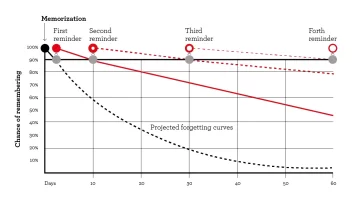
This strategy utilizes the "spacing effect" and it's explained well here.
You can book time in your calendar 2, 5, 10, 30, and 60 days out to go over specific material - or you can use a tool like Anki to convert your DIY quizzes into flashcards and leave it to the software to prompt you at the key times. Here is a good article on how you would use Anki to help you learn how to code.
3) Embrace your multiple intelligences
You may have heard that we all have "learning styles", for example we are auditory/visual etc.
This theory was fashionable when I was at school but is not supported by evidence. It's been debunked repeatedly.
We all have a unique mix of intelligences, and our learning should reflect that too! Listen to podcasts, watch videos, read books, take courses - mix up your knowledge inputs and immerse yourself in the topic you want to master.
4) Interleave and mix it up
Interleaving means mixing up study and practice in different areas and topics, contrasted with "blocked practice"
(focusing exclusively on one topic before moving on). Interleaving study and practice is known to improve learning.
For example, let's say you want to attain advanced knowledge of cryptocurrency.
To get a total understanding of the topic it would work well to mix up study of:
- Monetary history
- Blockchain technology
- Cryptography
- Market dynamics
- The use cases of different platforms (ETH, XRP, BTC, etc)
- Key figures in the field
If you want to learn digital marketing it would work well to mix up learning on:
- Consumer psychology
- Analytics
- Copywriting
- SEO
- CRO
- UX principles
Rather than exclusively studying the topics one by one.
Of course, some topics require prior knowledge - and we must start at the foundational ones if this is the case. The idea is to gain knowledge in parallel areas simultaneously forming a mutually supportive conceptual web.
5) Elaborate!
Elaboration is the practice of giving new material meaning in your own words and relating it to what you already know. The more you learn, the more you can learn. This is because the more you can relate new concepts to prior knowledge that you have already mastered, the stronger the knowledge will be.
This is similar to the "Feynmann method".
Every time I learn something new now I try to write it out in a blog post, Twitter thread, and explain it to my girlfriend. I also try to bullet point a list of all the ways I see the concept applying to things that I already know about. This has helped me significantly.
6) Making a Learning Plan
In the excellent book Ultralearning, Scott H Young recommends that we create our own "learning projects" like so:
Phase A: Research
Phase B: Schedule
You should take your learning project seriously. That means scheduling it and blocking off time like you would any other activity. How much time will you commit? What's the end date? What days and times will you study and practice? Remember that shorter sessions spread out seem to produce better results.
Phase C: Execution
Now it's time to put your plan into action start learning.
Make sure that you are:
It's important to maintain a growth mindset, remembering that there's no such thing as failure when it comes to lifelong learning and investing in yourself!
This is just a tiny fraction of the rabbit hole I've been going down with this topic. If there is interest I'll post more specific and well structured guides.
Here are a few helpful articles and resources:
Here are some thoughts and tips from my research into this topic:
Mindset
Learning should not be easy - the most productive learning is very hard work, you should almost feel "brain ache" during and afterwards. As the authors of "Make it stick, the science of successful learning" put it:
"Learning that is easy is like writing in the sand"
So whenever you are gearing up to learn something new - accept and embrace that it will be hard. Most real rewards in life are functions of hard work and effort.Embrace it.
Just working hard though is not enough! As most of us know, there's a big difference between working hard and working smart. It's not unusual to work extremely hard on tasks that are a complete waste of time! This is true of the most common, "conventional wisdom" methods of learning like:
- Rereading content
- Reviewing notes
- Highlighting
- Mass practice
So, what should one do instead?
1) To learn - retrieve
Rather than re-reading a text, re-watching a lecture, or pouring over notes - you focus your efforts onto remembering the core lessons and concepts of the content. A simple quiz at the end of a lecture, chapter, or course section is far more effective than rereading or reviewing notes.
Before you go over notes, always put effort first into recalling the information and concepts - and only go back to notes to verify your memories or to fill in parts that you have forgotten.
2) Interrupt Forgetting
I recommend having two notebooks when learning. One is for standard notes of key concepts and facts, another is to convert them into specific questions. At the end of every learning session you finish up with a focused period of going through your questions and retrieving the answers from your mind.
This isn't the end though.
We all have a "forgetting curve" - key times after the first exposure to material that we are most prone to forgetting. The key is to "interrupt" forgetting at just the right time to help the knowledge into your long term memory.
This strategy utilizes the "spacing effect" and it's explained well here.
You can book time in your calendar 2, 5, 10, 30, and 60 days out to go over specific material - or you can use a tool like Anki to convert your DIY quizzes into flashcards and leave it to the software to prompt you at the key times. Here is a good article on how you would use Anki to help you learn how to code.
3) Embrace your multiple intelligences
You may have heard that we all have "learning styles", for example we are auditory/visual etc.
This theory was fashionable when I was at school but is not supported by evidence. It's been debunked repeatedly.
We all have a unique mix of intelligences, and our learning should reflect that too! Listen to podcasts, watch videos, read books, take courses - mix up your knowledge inputs and immerse yourself in the topic you want to master.
"We all have multiple intelligences to bear on learning, and you learn better when you "go wide", drawing on all your aptitudes and resourcefulness, than when you limit your instruction to the form you find most amenable"
4) Interleave and mix it up
Interleaving means mixing up study and practice in different areas and topics, contrasted with "blocked practice"
(focusing exclusively on one topic before moving on). Interleaving study and practice is known to improve learning.
For example, let's say you want to attain advanced knowledge of cryptocurrency.
To get a total understanding of the topic it would work well to mix up study of:
- Monetary history
- Blockchain technology
- Cryptography
- Market dynamics
- The use cases of different platforms (ETH, XRP, BTC, etc)
- Key figures in the field
If you want to learn digital marketing it would work well to mix up learning on:
- Consumer psychology
- Analytics
- Copywriting
- SEO
- CRO
- UX principles
Rather than exclusively studying the topics one by one.
Of course, some topics require prior knowledge - and we must start at the foundational ones if this is the case. The idea is to gain knowledge in parallel areas simultaneously forming a mutually supportive conceptual web.
5) Elaborate!
Elaboration is the practice of giving new material meaning in your own words and relating it to what you already know. The more you learn, the more you can learn. This is because the more you can relate new concepts to prior knowledge that you have already mastered, the stronger the knowledge will be.
This is similar to the "Feynmann method".
Step 1
Write the name of the concept at the top of a blank piece of paper.
Step 2
Write down an explanation of the concept on the page. Use plain English. Pretend you are teaching it to someone else (e.g a new student). This should highlight what you understand, but more importantly pinpoint what you don't quite know.
Step 3
Review what you have pinpointed you don't know. Go back to the source material, re-read, and re-learn it. Repeat Step 2.
Step 4
If you are using overly wordy or confusing language (or simply paraphrasing the source material) try again so you filter the content. Simplify your language, and where possible use simple analogy.
Every time I learn something new now I try to write it out in a blog post, Twitter thread, and explain it to my girlfriend. I also try to bullet point a list of all the ways I see the concept applying to things that I already know about. This has helped me significantly.
6) Making a Learning Plan
In the excellent book Ultralearning, Scott H Young recommends that we create our own "learning projects" like so:
Phase A: Research
- Identify topic + scope
- Gather resources:
- Research other's paths:
- Define practice:
Phase B: Schedule
You should take your learning project seriously. That means scheduling it and blocking off time like you would any other activity. How much time will you commit? What's the end date? What days and times will you study and practice? Remember that shorter sessions spread out seem to produce better results.
Phase C: Execution
Now it's time to put your plan into action start learning.
Make sure that you are:
- Regularly testing yourself
- Harnessing the spacing effect and retrieval practice
- Using the Feynman technique and elaboration
- Applying what you've learned to existing knowledge
- Avoiding "illusions of knowing"
- Getting help and feedback from people knowledgeable in the field as much as possible
It's important to maintain a growth mindset, remembering that there's no such thing as failure when it comes to lifelong learning and investing in yourself!
This is just a tiny fraction of the rabbit hole I've been going down with this topic. If there is interest I'll post more specific and well structured guides.
Here are a few helpful articles and resources:
- Learning how to learn (coursera course)
- Scott H Young's site and book
- Nat Eliason's "Sandbox method"
- Farnham Street's learning section
- Make it Stick - the science of successful learning (book)
Dislike ads? Become a Fastlane member:
Subscribe today and surround yourself with winners and millionaire mentors, not those broke friends who only want to drink beer and play video games. :-)
Access Restricted: Unlock 1,000,000+ Posts
Stop Peeking Through the Keyhole.
Open the Door.
You hit a wall because the best advice isn't free—it's earned. Since 2007, MJ DeMarco has been active here daily (99.9% active rate), building a war room for entrepreneurs who refuse to settle for mediocrity.
- Active Daily: Life-changing content posted dozens of times every day. No dead threads.
- MJ's Inner Circle: Direct access to the author of The Millionaire Fastlane.
- Vetted Network: Connect with founders scaling to 7 and 8 figures.
- Proven Roadmaps: Strategy over motivation. Execution over "hustle porn."
"SCALED TO 6-FIGURE MONTHS"
"Tips and advice here saved me from huge mistakes, others allowed me to scale my business to 6-figure months."— User MitchC
"INSANE QUALITY OF PEOPLE"
"The number of high quality people I've met from this forum has been insane. All of it predicated on building real value."— User Richard Peck
"You are the average of the five people you surround yourself with."
Are you surrounding yourself with success?