Short intro
Hi everyone,
My name is Valery. I’m an industrial project manager with an engineering and economics background. I’ve already posted my introduction, so here I’ll focus on one thing only – my work on HBF (Home Building Factory).
What HBF is
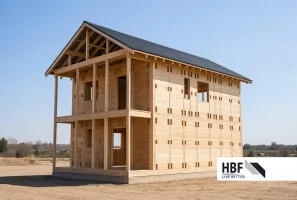
HBF (Home Building Factory) is a modular industrial house-building plant that uses plantation-grown timber as the main raw material. The core idea:
– Use plantation timber instead of cutting old-growth forest.
– Turn low-value logs into high-value prefabricated housing elements.
– Produce modular components that can be assembled quickly on site.
– Build a repeatable “factory + system” that can be copied to different regions/countries.
Why I believe HBF is a Fastlane business
– Need: Many countries face a shortage of modern, affordable housing and a growing demand for “green” construction.
– Entry: Industrial house-building with plantation timber requires technology, engineering, capital and know-how – it’s not easy to copy.
– Control: The value is in the plant design, processes, supply chain and brand, not just in commodity timber.
– Scale: Once the first plant and system are working, the model can be replicated as a network of plants or via JV/franchise.
– Time: The goal is to build a system where the owner’s time is not tied to every single project – the factory and operations run as a machine.
Where I am now
– The technical concept of the plant and the production flow is defined.
– I have previous experience with timber construction technology and industrial projects, including an almost-launched HBF-style JV project in Malaysia (Penang). That project failed on the partnership level, not on the technical level.
– I’m rebuilding the financial model (CAPEX/OPEX, IRR, NPV, payback, cashflow) for a pilot plant with an annual capacity of roughly 50,000–100,000 m² of housing.
– I’m working on positioning: export-oriented product, use of plantation timber, and a model that can be adapted to different jurisdictions (first of all I’m looking at countries with timber resources and relatively stable legal frameworks).
– I have a small core team that is ready to relocate and build something around HBF once we have a solid base.
What I’m looking for here
Right now I’m not here to pitch for money. First I want to make sure the model is sharp and realistic. I’d really appreciate feedback and experience from members who have:
– Built or operated manufacturing plants (especially construction materials or prefab housing).
– Structured JV or franchise-type deals for industrial businesses.
– Exported high value-added products from “resource” countries.
Some specific questions I’m thinking about:
1) For those who launched factories: what were the biggest “hidden killers” in your first plant (CAPEX overruns, working capital, market adoption, regulations, something else)?
2) For those who’ve used a franchise/licensing model in physical businesses: what are the key mistakes to avoid when you’re “selling a system” rather than just a single plant?
3) If you had to choose a country for an export-oriented timber housing plant today, what factors would be non-negotiable for you (legal, tax, logistics, labour, etc.)?
I’ll use this thread to document my progress: decisions, numbers, wins, mistakes and corrections. Any tough questions, criticism or reality checks are very welcome.
Thank you for reading.
Hi everyone,
My name is Valery. I’m an industrial project manager with an engineering and economics background. I’ve already posted my introduction, so here I’ll focus on one thing only – my work on HBF (Home Building Factory).
What HBF is
HBF (Home Building Factory) is a modular industrial house-building plant that uses plantation-grown timber as the main raw material. The core idea:
– Use plantation timber instead of cutting old-growth forest.
– Turn low-value logs into high-value prefabricated housing elements.
– Produce modular components that can be assembled quickly on site.
– Build a repeatable “factory + system” that can be copied to different regions/countries.
Why I believe HBF is a Fastlane business
– Need: Many countries face a shortage of modern, affordable housing and a growing demand for “green” construction.
– Entry: Industrial house-building with plantation timber requires technology, engineering, capital and know-how – it’s not easy to copy.
– Control: The value is in the plant design, processes, supply chain and brand, not just in commodity timber.
– Scale: Once the first plant and system are working, the model can be replicated as a network of plants or via JV/franchise.
– Time: The goal is to build a system where the owner’s time is not tied to every single project – the factory and operations run as a machine.
Where I am now
– The technical concept of the plant and the production flow is defined.
– I have previous experience with timber construction technology and industrial projects, including an almost-launched HBF-style JV project in Malaysia (Penang). That project failed on the partnership level, not on the technical level.
– I’m rebuilding the financial model (CAPEX/OPEX, IRR, NPV, payback, cashflow) for a pilot plant with an annual capacity of roughly 50,000–100,000 m² of housing.
– I’m working on positioning: export-oriented product, use of plantation timber, and a model that can be adapted to different jurisdictions (first of all I’m looking at countries with timber resources and relatively stable legal frameworks).
– I have a small core team that is ready to relocate and build something around HBF once we have a solid base.
What I’m looking for here
Right now I’m not here to pitch for money. First I want to make sure the model is sharp and realistic. I’d really appreciate feedback and experience from members who have:
– Built or operated manufacturing plants (especially construction materials or prefab housing).
– Structured JV or franchise-type deals for industrial businesses.
– Exported high value-added products from “resource” countries.
Some specific questions I’m thinking about:
1) For those who launched factories: what were the biggest “hidden killers” in your first plant (CAPEX overruns, working capital, market adoption, regulations, something else)?
2) For those who’ve used a franchise/licensing model in physical businesses: what are the key mistakes to avoid when you’re “selling a system” rather than just a single plant?
3) If you had to choose a country for an export-oriented timber housing plant today, what factors would be non-negotiable for you (legal, tax, logistics, labour, etc.)?
I’ll use this thread to document my progress: decisions, numbers, wins, mistakes and corrections. Any tough questions, criticism or reality checks are very welcome.
Thank you for reading.
Dislike ads? Become a Fastlane member:
Subscribe today and surround yourself with winners and millionaire mentors, not those broke friends who only want to drink beer and play video games. :-)
Last edited:
Access Restricted: Unlock 1,000,000+ Posts
Stop Peeking Through the Keyhole.
Open the Door.
You hit a wall because the best advice isn't free—it's earned. Since 2007, MJ DeMarco has been active here daily (99.9% active rate), building a war room for entrepreneurs who refuse to settle for mediocrity.
- Active Daily: Life-changing content posted dozens of times every day. No dead threads.
- MJ's Inner Circle: Direct access to the author of The Millionaire Fastlane.
- Vetted Network: Connect with founders scaling to 7 and 8 figures.
- Proven Roadmaps: Strategy over motivation. Execution over "hustle porn."
"SCALED TO 6-FIGURE MONTHS"
"Tips and advice here saved me from huge mistakes, others allowed me to scale my business to 6-figure months."— User MitchC
"INSANE QUALITY OF PEOPLE"
"The number of high quality people I've met from this forum has been insane. All of it predicated on building real value."— User Richard Peck
"You are the average of the five people you surround yourself with."
Are you surrounding yourself with success?