- Joined
- May 1, 2011
- Messages
- 9,208
Rep Bank
$8,512
$8,512
User Power: 444%
Tap into the fastest growing discovery engine - AI chatbots - and learn how to improve your visibility through GEO/AEO.
I've only started learning so I'll update this thread periodically with new resources. Feel free to share your own experiences and add whatever you found valuable.
Starting with a quick primer.
What Is GEO and AEO?
GEO stands for Generative Engine Optimization. Some use the term AEO which stands for Answer Engine Optimization. In both cases, the concept is the same - it's about improving the visibility of your business or product in AI chatbots like ChatGPT, Claude, Gemini, Google Overviews, Perplexity, etc. You may be tempted to think of it as the "new" SEO but there are some important differences (covered later).
How Does AI Search Work?
AI models draw from their own training data first. If you ask "what's 2+2" the answer comes immediately. But for more complex queries, in many cases models need to turn to web search to formulate a response. When a user enters a detailed, possibly messy prompt, the answer engine turns it into multiple search queries. One long prompt turns into numerous searches which are later used to create a response.
For each query, a model looks at the potential website's URL, title, snippet, and sometimes date. If it finds it relevant, it visits the website to extract a piece of the answer. This is why it's important to have your robots.txt file allowing bots.
Your website needs to be accessible publicly. If it's behind paywall or some kind of authentication, your content is invisible to AI.
Your content needs to be formatted to "match the shape of the answers the AI is already fetching" (source). This means utility-first content (comparative format, data, important answers presented upfront instead of being buried in the text) over marketing copy and fluff.
Lastly, your content needs to be easily extractable - text format, with headings, bullet points, and short paragraphs, not hidden in images, videos, or behind some fancy code.
Why Should You Care?
SEO traffic is steadily decreasing. In early 2026, zero-click searches accounted for about 68% of all US Google searches, up from 60% in 2024 (source). ChatGPT is now the fifth most visited website in the world. As of May 2026, it has 1 billion global monthly active app users. This tendency will only grow, with fewer actual Google searches and more and more people turning to AI search for answers and buying recommendations.
In GEO, the stakes are higher because there's no page two. You're in the AI answer or you don't exist.
Few businesses are optimizing for AI because it's opaque, unproven, and hard to track. If you start today, you can beat your competition and make up for the inevitable decline in SEO traffic. And the best part is that it's not just a guess - there's zero doubt that AI searches are taking over. AI-assisted shopping is already a thing (like ChatGPT Shopping) and more and more consumers are using AI chatbots for getting information, comparison, and purchasing decisions.
Isn't It Just a New Fancy Term for SEO?
There's a noticeable correlation between SEO factors and AI visibility. According to one study, ranking on page one of Google showed a strong correlation (~0.65) with AI mentions. But interestingly, and that's one of the key differences between SEO and GEO, backlinks by themselves show little correlation (even if they do impact Google rankings a lot).
Brand mentions (not necessarily backlinks) and their frequency, context, and where they appear (reputable sources that AI uses for citations or to update its model) are now more important. So you don't need actual backlinks - you need brand recognition through media mentions.
Another difference is that search terms are evolving from simple SEO keywords ("best mountain bikes for tall guys") to specific prompts that may often be typed only once and be messy ("I'm a 6'6 man weighing 250 pounds, what mountain bike would be the best option for me in Utah if I have bad knees and struggle to climb over long distances?"). Such prompts have more intent behind them and present new content and product opportunities.
The entire buying experience changes. In SEO, someone clicks a result, goes to your website, and decides there. In GEO, a potential buyer may never visit your website until they've already made a decision and only have to click "add to cart."
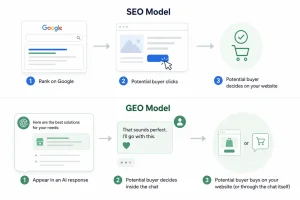
(concept by me, illustration by ChatGPT)
How Can I Improve My Visibility in AI Chatbots?
There are three main levers: owned media (your website and other channels), earned media (news, blogs, Wikipedia), and community/influencer marketing (Reddit, YouTube, forums).
For owned media, content marketing still plays a big role. But generic content is of no use. Specific, relevant, unique, and credible content is more important than ever before. According to a 2024 Princeton paper, there are four methods to improve your content that bring the best results (note that it's not exact science since the study wasn't done with live chatbots):
For earned media, businesses need to focus on visibility through trusted platforms and websites. This means all the sources that AI models are trained on periodically as well as every other online media appearance that AI models search for to generate a response.
Community/influencer marketing is arguably even more important for many niches, with Reddit alone having a disproportionate impact on results.
According to Otterly.ai study on 10,000 domain citations on Google, ChatGPT, and Perplexity, here are four most important sources of citations:

If you want the biggest boost in your AI visibility, Reddit and Youtube are realistically your best levers. Reddit marketing is a world of its own, while YouTube could be theoretically easier to manage for still a noticeable impact (through influencer outreach).
Note that citation sources can change depending on the niche. In one niche, Wikipedia may account for 10% of citations while in another it may be completely invisible and taken by blogs or comparison websites. You can learn what sources AI takes into account in your niche by using GEO tools like Otterly, Profound, Ahrefs Brand Radar, Peec AI, and many more. Having your business appear in these citation sources will improve your visibility in AI search.
For example, here are top10 citation sources for 15 prompts related to one forum member's business:
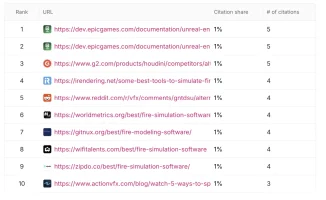
As you can see, it's a mix of niche websites, 1 Reddit thread, and comparison websites (like G2), with equal citation share and no clear dominant source.
And here's a DTC B2C business I've been analyzing for practice with a completely different citation source breakdown:
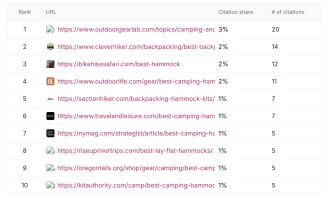
Here, every single citation source in top10 is a niche website with top sites providing more citations. And it's much simpler to get mentioned in these articles since they tend to be user-focused and want to compare as many options as possible.
In the next post (coming soon), to explain this more in practice, I'll share an actual real-world analysis of a brand and what steps they could take to improve their visibility in AI chatbots.
I've only started learning so I'll update this thread periodically with new resources. Feel free to share your own experiences and add whatever you found valuable.
Starting with a quick primer.
What Is GEO and AEO?
GEO stands for Generative Engine Optimization. Some use the term AEO which stands for Answer Engine Optimization. In both cases, the concept is the same - it's about improving the visibility of your business or product in AI chatbots like ChatGPT, Claude, Gemini, Google Overviews, Perplexity, etc. You may be tempted to think of it as the "new" SEO but there are some important differences (covered later).
How Does AI Search Work?
AI models draw from their own training data first. If you ask "what's 2+2" the answer comes immediately. But for more complex queries, in many cases models need to turn to web search to formulate a response. When a user enters a detailed, possibly messy prompt, the answer engine turns it into multiple search queries. One long prompt turns into numerous searches which are later used to create a response.
For each query, a model looks at the potential website's URL, title, snippet, and sometimes date. If it finds it relevant, it visits the website to extract a piece of the answer. This is why it's important to have your robots.txt file allowing bots.
Your website needs to be accessible publicly. If it's behind paywall or some kind of authentication, your content is invisible to AI.
Your content needs to be formatted to "match the shape of the answers the AI is already fetching" (source). This means utility-first content (comparative format, data, important answers presented upfront instead of being buried in the text) over marketing copy and fluff.
Lastly, your content needs to be easily extractable - text format, with headings, bullet points, and short paragraphs, not hidden in images, videos, or behind some fancy code.
Why Should You Care?
SEO traffic is steadily decreasing. In early 2026, zero-click searches accounted for about 68% of all US Google searches, up from 60% in 2024 (source). ChatGPT is now the fifth most visited website in the world. As of May 2026, it has 1 billion global monthly active app users. This tendency will only grow, with fewer actual Google searches and more and more people turning to AI search for answers and buying recommendations.
In GEO, the stakes are higher because there's no page two. You're in the AI answer or you don't exist.
Few businesses are optimizing for AI because it's opaque, unproven, and hard to track. If you start today, you can beat your competition and make up for the inevitable decline in SEO traffic. And the best part is that it's not just a guess - there's zero doubt that AI searches are taking over. AI-assisted shopping is already a thing (like ChatGPT Shopping) and more and more consumers are using AI chatbots for getting information, comparison, and purchasing decisions.
Isn't It Just a New Fancy Term for SEO?
There's a noticeable correlation between SEO factors and AI visibility. According to one study, ranking on page one of Google showed a strong correlation (~0.65) with AI mentions. But interestingly, and that's one of the key differences between SEO and GEO, backlinks by themselves show little correlation (even if they do impact Google rankings a lot).
Brand mentions (not necessarily backlinks) and their frequency, context, and where they appear (reputable sources that AI uses for citations or to update its model) are now more important. So you don't need actual backlinks - you need brand recognition through media mentions.
Another difference is that search terms are evolving from simple SEO keywords ("best mountain bikes for tall guys") to specific prompts that may often be typed only once and be messy ("I'm a 6'6 man weighing 250 pounds, what mountain bike would be the best option for me in Utah if I have bad knees and struggle to climb over long distances?"). Such prompts have more intent behind them and present new content and product opportunities.
The entire buying experience changes. In SEO, someone clicks a result, goes to your website, and decides there. In GEO, a potential buyer may never visit your website until they've already made a decision and only have to click "add to cart."
(concept by me, illustration by ChatGPT)
How Can I Improve My Visibility in AI Chatbots?
There are three main levers: owned media (your website and other channels), earned media (news, blogs, Wikipedia), and community/influencer marketing (Reddit, YouTube, forums).
For owned media, content marketing still plays a big role. But generic content is of no use. Specific, relevant, unique, and credible content is more important than ever before. According to a 2024 Princeton paper, there are four methods to improve your content that bring the best results (note that it's not exact science since the study wasn't done with live chatbots):
- Cite sources - by providing verifiable sources, you improve your credibility. In the study, this was associated with about 30-40% increase in AI visibility.
- Incorporate quotes - by adding quotes from experts, you boost your credibility and make the content more engaging. In the study, this was associated with about 30-40% increase in AI visibility.
- Add statistics - by adding statistics, you... yeah, you guessed it. You improve your credibility. In the study, this was associated with about 30-40% increase in AI visibility.
- Make your content simple - natural, jargon-free language makes your content more accessible. In the study, this was associated with about 15-30% increase in AI visibility.
For earned media, businesses need to focus on visibility through trusted platforms and websites. This means all the sources that AI models are trained on periodically as well as every other online media appearance that AI models search for to generate a response.
Community/influencer marketing is arguably even more important for many niches, with Reddit alone having a disproportionate impact on results.
According to Otterly.ai study on 10,000 domain citations on Google, ChatGPT, and Perplexity, here are four most important sources of citations:
If you want the biggest boost in your AI visibility, Reddit and Youtube are realistically your best levers. Reddit marketing is a world of its own, while YouTube could be theoretically easier to manage for still a noticeable impact (through influencer outreach).
Note that citation sources can change depending on the niche. In one niche, Wikipedia may account for 10% of citations while in another it may be completely invisible and taken by blogs or comparison websites. You can learn what sources AI takes into account in your niche by using GEO tools like Otterly, Profound, Ahrefs Brand Radar, Peec AI, and many more. Having your business appear in these citation sources will improve your visibility in AI search.
For example, here are top10 citation sources for 15 prompts related to one forum member's business:
As you can see, it's a mix of niche websites, 1 Reddit thread, and comparison websites (like G2), with equal citation share and no clear dominant source.
And here's a DTC B2C business I've been analyzing for practice with a completely different citation source breakdown:
Here, every single citation source in top10 is a niche website with top sites providing more citations. And it's much simpler to get mentioned in these articles since they tend to be user-focused and want to compare as many options as possible.
In the next post (coming soon), to explain this more in practice, I'll share an actual real-world analysis of a brand and what steps they could take to improve their visibility in AI chatbots.
Dislike ads? Become a Fastlane member:
Subscribe today and surround yourself with winners and millionaire mentors, not those broke friends who only want to drink beer and play video games. :-)
Access Restricted: Unlock 1,000,000+ Posts
Stop Peeking Through the Keyhole.
Open the Door.
You hit a wall because the best advice isn't free—it's earned. Since 2007, MJ DeMarco has been active here daily (99.9% active rate), building a war room for entrepreneurs who refuse to settle for mediocrity.
- Active Daily: Life-changing content posted dozens of times every day. No dead threads.
- MJ's Inner Circle: Direct access to the author of The Millionaire Fastlane.
- Vetted Network: Connect with founders scaling to 7 and 8 figures.
- Proven Roadmaps: Strategy over motivation. Execution over "hustle porn."
"SCALED TO 6-FIGURE MONTHS"
"Tips and advice here saved me from huge mistakes, others allowed me to scale my business to 6-figure months."— User MitchC
"INSANE QUALITY OF PEOPLE"
"The number of high quality people I've met from this forum has been insane. All of it predicated on building real value."— User Richard Peck
"You are the average of the five people you surround yourself with."
Are you surrounding yourself with success?